

Essay
The Rubber Duck Can Answer Back Now
Rubber duck debugging worked because the duck could not argue. Now the sounding board answers back, which is useful right up to the point where the thing that produced the work is also the thing declaring it correct.
When I first learned programming in school, I’d already been coding for years. But that first formal programming class introduced me to something I hadn’t encountered before: rubber duck debugging. (We called it “rubber ducky programming”, but “debugging” is the actual, technical name for it.)
The idea is wonderfully low-tech. Put a rubber duck next to your computer. When you’re stuck, explain the problem to the duck.
The duck does absolutely nothing. That’s sort of the point.
Explaining the problem forces you to slow down and make your assumptions explicit. Somewhere between “this function should return…” and “and then this variable…”, you frequently hear yourself say the thing that reveals the problem.
Years later, when I taught computer science, I used pair programming with my students. One student was the driver, working at the keyboard. The other was the navigator, watching, asking questions, thinking about where they were going next.
To me, it felt like an extension of the rubber duck. Except now the rubber duck could answer back.
These days, AI often fills both roles for me. Not just when I’m programming, either.
Thinking out loud
One of the most useful ways I’ve found to work with AI starts before there is much of a product at all.
I talk. Sometimes I type, but increasingly I dictate into Wispr Flow and dump whatever is in my head into Claude, “dump” is the appropriate word.
The first version might contain a goal, half of an architecture, three things I suddenly remembered while explaining the first thing, a concern about something that might happen six steps later, and a sentence beginning with, “Actually, wait…”
It is not a prompt-engineering masterclass. It is thinking out loud.
Claude’s first job isn’t necessarily to produce anything. Often its job is to help me figure out what I just said. It can identify the pieces, point out contradictions, ask questions when something is missing, and help turn the conversation into structure.
For coding projects, that may eventually become a CLAUDE.md, a ROADMAP.md, and a BACKLOG.md. The messy conversation becomes a description of what we’re building, where we’re going, and what remains to be done.
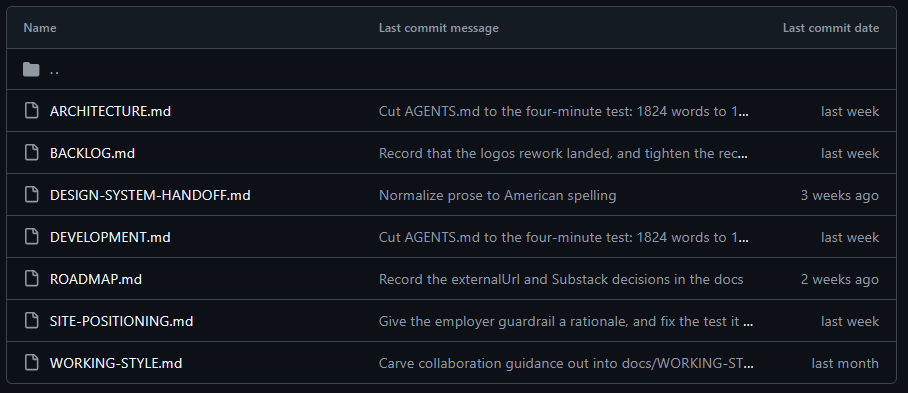
CLAUDE.md slim enough to function as a good handoff document, there end up being many more.That process matters to me because I don’t always think linearly. I may know where I want to end up without knowing all the intermediate steps yet. Or I may recognize an important constraint while I’m talking about something that seems completely unrelated.
Trying to force all of that into a perfectly constructed prompt before I begin would defeat much of the reason I’m using the tool.
The conversation is part of the thinking.
The danger of a rubber duck that answers back
There is, of course, a rather important difference between Claude and the plastic duck.
The plastic duck can’t be confidently wrong. It also can’t subtly steer my thinking toward its own interpretation of the problem.
Once the sounding board can answer back, I have gained something useful, but I’ve introduced a new failure mode.
The same is true of pair programming. A navigator isn’t automatically correct because someone else is driving. Two people can reinforce the same bad assumption. One can defer too much to the other. Someone still has to decide whether the solution actually works.
AI makes that problem more interesting because it can occupy several roles very quickly. I can ask the same system to help me define the problem, develop a solution, implement it, review it, and tell me whether it succeeded.
That’s convenient, but not much of a control system.
If the same agent defines what “correct” means, produces the work, and then declares its own work correct, I haven’t created meaningful review. I’ve created a very elaborate form of “looks good to me.”
That is where my thinking about AI-assisted work has been changing.
The conversation is useful. But the conversation isn’t the whole workflow.
From pair programming to an engineering process
I recently commented on a LinkedIn post that described a more structured approach: separation of duties, independent review, gates, and feedback loops.
What struck me was that none of those things contradicted the way I already liked working. They showed me what comes next.
I don’t need to abandon the conversational process that helps me think. I need to surround it with enough structure that the strengths of that process don’t become its weaknesses.
Claude can still be my rubber duck. It can still be my navigator. It can help me turn a pile of thoughts into a roadmap. It can help me work through implementation. It can notice something I missed and ask me a question that sends the project in a better direction.
But as the work becomes consequential, the roles need to separate.
The thing that helped define the answer shouldn’t necessarily be the only thing checking the answer. The thing that generated the code shouldn’t be the only thing deciding whether the code works. A review shouldn’t merely ask the author to look at its work again and try harder.
There should be tests, evidence, independent checks, or another reviewer whose job isn’t simply to continue the same train of thought.
That’s less like replacing pair programming than scaling it into an engineering process.
So whose work is it?
This leads to another question I’ve been thinking about for a while: what makes AI-assisted work authentic?
I think we sometimes collapse authenticity and transparency into the same idea. They aren’t.
Transparency is about being truthful about the process. If it matters that AI was used, I shouldn’t pretend that it wasn’t. In environments where provenance, verification, or accountability matters, there may be very good reasons to document exactly what AI did, what evidence supported the result, and who reviewed it.
Authenticity is something different. Authenticity asks whether the finished work actually represents what I think.
That matters to me particularly in writing.
I use AI when I write. Sometimes extensively. I may talk through an idea with it. Ask it to challenge an argument. Have it reorganize something that wandered in three directions at once. Ask why a paragraph doesn’t work. Let it propose language. Reject that language. Rewrite it. Put back a sentence it tried to remove because, yes, the slightly awkward version is actually how I would say it.
By the time I publish something, I don’t particularly care whether I personally typed every word.
I care whether I would stand behind every word.
Those are not the same thing.
If Claude suggests an argument I don’t believe, it doesn’t belong in the piece. If it writes a sentence that sounds impressive but says more than the evidence supports, it doesn’t belong in the piece. If it smooths something so thoroughly that I can no longer hear myself saying it, it probably doesn’t belong in the piece either.
And if it notices a hole in my reasoning that causes me to change what I think?
That’s not evidence that the work is less authentic. That’s what I wanted the sounding board for.
The rubber duck can answer back now. Sometimes it even disagrees.
The human part didn’t disappear
I don’t think the interesting future of AI-assisted work is one where the human carefully writes instructions and the machine obediently produces finished products.
That model still puts all of the interesting thinking on one side of the interaction.
What I find much more useful is iterative. I explain something. The system reflects it back. I notice that isn’t quite what I meant. I clarify. It asks something I hadn’t considered. I rethink part of the problem.
Eventually we have enough structure to start building. Then the nature of the relationship changes again. We move from exploration toward execution, and from execution toward verification.
Different stages need different kinds of interaction. And, increasingly, I think they need different controls.
The lesson I took from rubber duck debugging was never that the duck solves the problem. The lesson was that thinking becomes easier to examine once you get it outside your own head.
Pair programming added another person who could question that thinking. AI makes that interaction available almost continuously.
That’s tremendously useful.
But if I’m going to use it seriously, I can’t stop at the conversation.
I have to decide where the conversation becomes a plan, where the plan becomes work, where the work gets checked, and what evidence tells me that the result deserves to survive.
The rubber duck may be considerably smarter now.
I’m still the one responsible for what leaves the desk.