

Mr. Pledger Stays After School
Fractional Distance along a Directed Line Segment, Revisited
A Common Core geometry standard asks students to find the point some fraction of the way along a line segment. I couldn't find it taught well in any textbook, so in 2020 I made a video of the three-step method I used with my students. Here it is again, with the method written out.

There’s a geometry standard in the Common Core that I never once found in a textbook. And I looked.
CCSS.Math.Content.HSG.GPE.B.6: Find the point on a directed line segment between two given points that partitions the segment in a given ratio.
In plainer terms: you have a point A and a point B, and you need the point that’s, say, seven-tenths of the way from A to B. Halfway is easy (that’s the midpoint, and students already know how to average two points). Seven-tenths isn’t, and the explanations I could find made it look much harder than it is.
I taught geometry for five of my twelve years in the classroom, and I had a specific way I taught this one. So in April 2020, with a lot of unexpected time at home, I recorded it: partly so my own students could review it, and partly for anyone else who needed it, since the standard wasn’t being presented very well anywhere I could find.
Position and motion
For almost every student, this is their first brush with a vector, so before any arithmetic I give them two ideas and two kinds of brackets. A point is a position, and it goes in parentheses. A vector is a motion, and it goes in angle brackets.
Then “directed line segment” is just another way of saying a point that moves to another point. The problem shows a move FROM one point TO another. You start at a position (x, y). You move ⟨h, k⟩, which is a motion, so it gets angle brackets. And you end up at a different position, (x + h, y + k), so that’s parentheses again. If you think about what’s going on (am I describing where something is, or how it moved?), you know which notation to use.
The method, in three steps
The example from the video goes from A(−7, 4) to B(8, −6), and asks for the point seven-tenths of the way from A to B. The direction matters: a directed line segment has a start and an end, and the question will tell you which is which.
- TO − FROM. Subtract where you start from where you end: B − A = (8 − (−7), −6 − 4) = ⟨15, −10⟩. That’s the displacement: a motion, not a position (15 to the right and 10 down), so it gets angle brackets. If the points are on a grid, you can also just count it: the horizontal distance and the vertical distance from A to B, with the sign telling you which way.
- Step 1 × fraction. Take the fraction of that movement, and “of” means multiply: 7/10 · ⟨15, −10⟩ = ⟨7/10 · 15, 7/10 · −10⟩ = ⟨10.5, −7⟩.
- Step 2 + FROM. Add that movement to where you started: ⟨10.5, −7⟩ + A(−7, 4) = (10.5 − 7, −7 + 4) = (3.5, −3).
That’s the whole thing. Notice that each step is named for what it is, not written in symbols. I’ve always found that helps: “to minus from” is something a student can say out loud and remember on a test, and it carries the direction with it, because swapping TO and FROM is exactly what changes the answer.
If you’ve seen the formula P(t) = A + t(B − A), this is that formula, taken one named step at a time. You can check the answer with the distance formula: the distance from A to (3.5, −3) should be seven-tenths of the distance from A to B.
Six years later
The video has had about 2,000 views since April 2020. That isn’t many by YouTube standards, and I’ve had videos get more views and more comments. What I like about this one is the shape of the curve: slow, steady, nearly a straight line, with a couple of spikes. People keep finding it, which tells me the gap it filled is still there. When I searched for “fractional distance along a line segment” on October 2, 2026, it came up first, just below Google’s AI answer.
It worked in the room, too. My students did well with it: the class average was well above passing, and most of them met or exceeded the standard on both the formative and the summative assessments.
Try it yourself
If you take the challenge from the end of the video, going from B to A instead, you should land somewhere different. That’s the “directed” part doing its job.
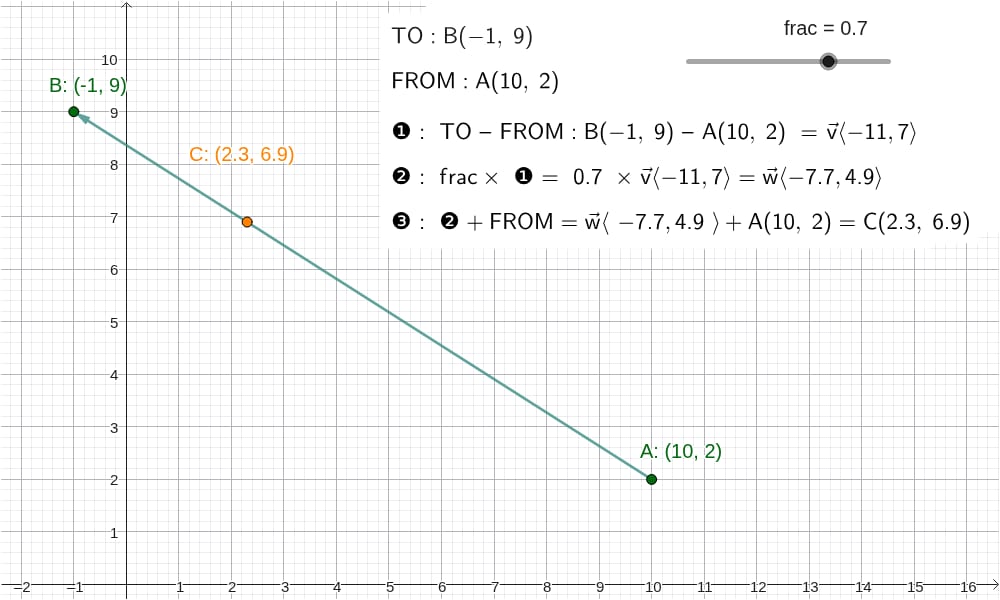
Turn your phone sideways for a bigger view.